
A personalized wellness plan is a custom-designed health strategy that uses your unique biology, lifestyle, and goals to improve how you feel and function every day. Generic advice fails most people because it ignores the factors that make you different: your stress load, your sleep patterns, your chronic pain history, and even your genetic makeup. Whether you are managing back pain in Pickerington or trying to reduce anxiety after a long Ohio winter, a tailored wellness strategy works because it starts with you, not a population average. This guide walks you through how these plans work, what data they use, and how to build one that actually sticks.
What is a personalized wellness plan, and what does it include?
A personalized wellness plan is a dynamic health protocol built around four stages: assessment, strategy design, intervention, and ongoing iteration. Each stage feeds into the next, so the plan evolves as you do. This replaces the old model of handing someone a generic meal plan or exercise routine and hoping for the best.
The assessment stage collects your full health picture. That means health history, current symptoms, sleep quality, stress levels, and ideally some clinical markers like blood work. The strategy design stage turns that data into a prioritized set of actions across nutrition, movement, sleep, and stress management. The intervention stage is where you actually do the work, and the iteration stage is where you review what is working and adjust.
Pro Tip: Think of your wellness plan as a living document, not a rulebook. The goal is to update it regularly based on real results, not to follow it perfectly from day one.
- Assessment. Gather health history, lifestyle data, and baseline biomarkers.
- Strategy design. Build a prioritized plan targeting your top health goals.
- Intervention. Apply targeted changes across sleep, nutrition, movement, and stress.
- Iteration. Review progress weekly and adjust based on measurable outcomes.
The iteration stage is where most people give up too soon. Weekly review rituals that assess improvements, struggles, and next adjustments are what keep a plan alive and effective. A quick 10-minute check-in every Sunday can tell you more than a quarterly doctor visit.
How do biomarkers and genetic data shape your plan?
Biomarkers are measurable indicators of your body’s current state. Blood glucose, cortisol, vitamin D, ferritin, and inflammatory markers like C-reactive protein all tell a story your symptoms alone cannot. When combined with genetic data, they give you a much sharper picture of what your body actually needs.
Genetic variants in key genes influence how you metabolize nutrients, respond to stress, and regulate sleep. Someone with a variant in the MTHFR gene, for example, may not convert folate efficiently and could benefit from methylated B vitamins rather than standard supplements. Generic advice misses this entirely.
The data layers that inform a well-built individualized fitness program and nutrition strategy include:
- Genetic profile. Identifies variants affecting nutrient metabolism, stress response, and sleep regulation.
- Blood markers. Tracks inflammation, hormone levels, glucose, and micronutrient status.
- Microbiome data. Reveals gut health patterns that affect mood, immunity, and digestion.
- Wearable metrics. Captures real-time data on heart rate variability, sleep stages, and activity levels.
AI-powered health plans now synthesize these diverse data layers to generate precise guidance on supplement dosages, meal timing, and lifestyle adjustments. That level of synthesis used to require a team of specialists. Wearables like continuous glucose monitors add another layer by showing how your blood sugar responds to specific foods, stress, or poor sleep in real time.
A holistic assessment that combines modern diagnostics with methods like Ayurvedic constitutional analysis delivers even stronger personalization. This integrative approach reduces adverse reactions and improves adherence because it accounts for your temperament, digestion type, and seasonal sensitivities alongside your lab results.

Pro Tip: You do not need every data layer at once. Start with a basic blood panel and a sleep tracker. Add genetic testing or microbiome analysis later when you have a clearer sense of your priorities.
What are the most common mistakes in building a wellness plan?
The biggest mistake people make is trying to fix everything at once. Focusing on 1 primary and 2 secondary goals rather than optimizing everything simultaneously improves both adherence and outcomes. When you chase six goals at once, you make progress on none of them.
A second common mistake is treating your plan as theoretically perfect but practically impossible. Sustainability and real-life fit matter more than scientific accuracy when a plan ignores your work schedule, family demands, or cultural food preferences. A plan you follow 80% of the time beats a perfect plan you abandon in two weeks.
Here is what expert-level personal health improvement actually looks like in practice:
- Choose one primary goal, such as reducing chronic pain or improving sleep quality.
- Select two supporting goals that reinforce the primary one, like stress reduction and anti-inflammatory nutrition.
- Build your daily habits around those three goals only.
- Resist adding new goals until the first set is stable and measurable.
Wellness coordinators who adapt plans continuously across movement, nutrition, recovery, sleep, and resilience pillars produce better outcomes than static programs. The reason is simple: life changes, and your plan needs to change with it. If you do not have access to a coordinator, a monthly self-review serves the same purpose. Check your daily habits against your stated goals and ask honestly whether your actions match your priorities.
How to create a wellness plan step by step
Building a custom health plan does not require a team of specialists or expensive testing. It requires honest self-assessment, a few high-leverage habits, and a commitment to reviewing your progress regularly.
Step 1: Define your primary wellness goal
Write it down in one sentence. “I want to reduce lower back pain so I can walk comfortably for 30 minutes” is a goal. “I want to feel better” is not. Specificity is what makes a goal measurable.
Step 2: Conduct a minimum viable assessment
You do not need a full genetic workup to start. A basic blood panel covering vitamin D, thyroid function, fasting glucose, and a complete blood count gives you enough to work with. Add a subjective assessment: rate your sleep quality, energy, stress, and pain on a scale of 1–10. These numbers become your baseline.
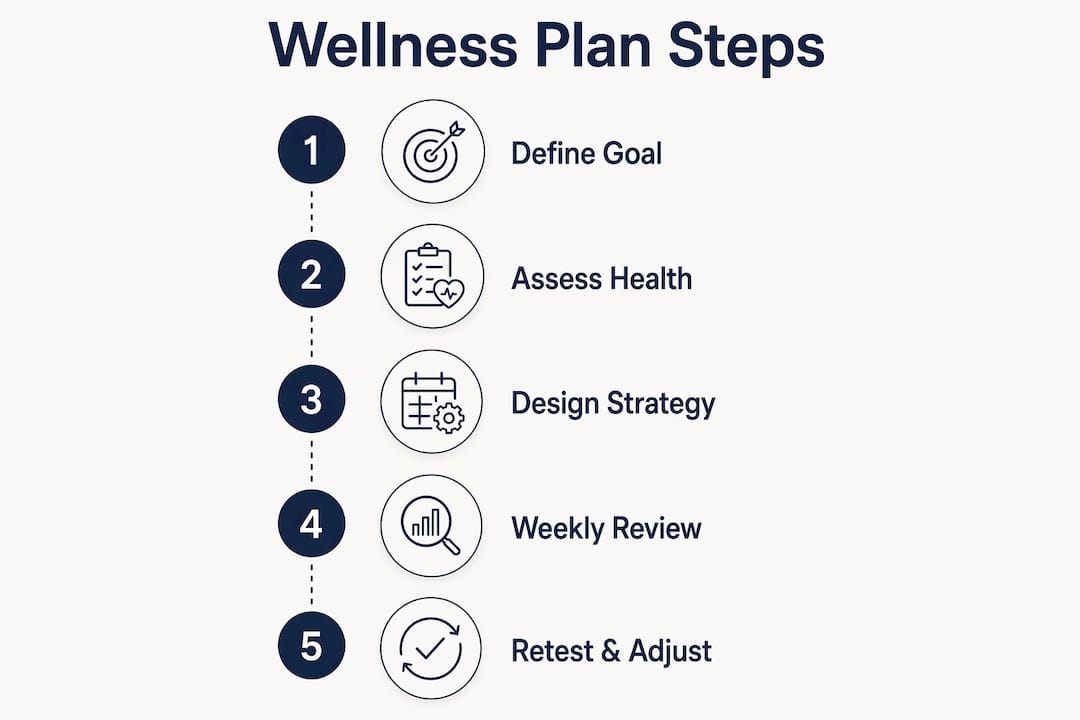
Step 3: Select your high-leverage habits
Biomarkers should guide sustainable lifestyle changes by pointing you toward the habits with the highest return. For most people, those habits are:
- Sleep. Aim for 7–9 hours with consistent bed and wake times.
- Protein intake. Prioritize adequate protein at each meal to support muscle repair and satiety.
- Daily movement. Even a 20-minute walk reduces inflammatory markers and improves mood.
- Stress management. Techniques like diaphragmatic breathing, hormonal balance practices, and regular bodywork lower cortisol measurably.
Step 4: Build a weekly review ritual
Set aside 10 minutes every week to answer three questions: What improved? What struggled? What will I adjust? Simple weekly reviews keep progress measurable and the plan dynamic. Write your answers in a notebook or a simple spreadsheet.
Step 5: Retest and recalibrate every 90 days
Repeat your baseline assessment every three months. Compare your subjective ratings and any clinical markers you tracked. Adjust your habits based on what the data shows, not what you feel like doing. This 90-day cycle is where real personal health improvement compounds over time.
| Step | Action | Frequency |
|---|---|---|
| Goal setting | Write one primary goal in one sentence | Once, then review quarterly |
| Baseline assessment | Blood panel plus subjective ratings | Every 90 days |
| Habit selection | Choose 3–5 high-leverage daily habits | Monthly review |
| Weekly check-in | Assess improvements, struggles, adjustments | Every week |
| Plan recalibration | Update goals and habits based on data | Every 90 days |
If you are managing chronic pain or stress, add therapeutic bodywork to your plan. Massage, infrared sauna, and craniosacral therapy are not luxuries. They are measurable interventions that reduce cortisol, improve circulation, and support recovery.
Key Takeaways
A personalized wellness plan works because it matches your biology, goals, and real-life constraints rather than applying generic advice that ignores all three.
| Point | Details |
|---|---|
| Four-stage process | Effective plans follow assessment, strategy design, intervention, and iteration in a continuous cycle. |
| Focus on fewer goals | Choose 1 primary and 2 supporting goals to improve adherence and avoid burnout. |
| Biomarkers as a compass | Use blood markers and genetic data to guide habit selection, not to create anxiety about results. |
| Weekly reviews matter | A 10-minute weekly check-in keeps your plan dynamic and prevents stagnation. |
| Sustainability beats perfection | A plan that fits your real life at 80% consistency outperforms a perfect plan you cannot maintain. |
What I have learned after years of watching people build wellness plans
I have seen a lot of people walk in with a stack of lab results, a new fitness tracker, and a plan that would exhaust a professional athlete. They are motivated, they are informed, and within six weeks they are burned out and back to square one.
The science of personalization is genuinely exciting. Genetic testing, continuous glucose monitoring, and AI-assisted health planning have changed what is possible. But the people who actually get better are not the ones with the most data. They are the ones who pick two or three things and do them consistently for months.
What I find most valuable about combining modern data with approaches like therapeutic massage and infrared sauna is that it addresses the body as a whole system. Stress drives inflammation. Inflammation drives pain. Pain disrupts sleep. Sleep disruption worsens stress. You cannot break that cycle with a supplement alone. You need interventions that work on the nervous system directly, and that is where hands-on therapies earn their place in any serious wellness plan.
The other thing I will say plainly: standard health advice fails a lot of people not because they lack willpower, but because the advice was never designed for their body. Generic recommendations ignore unique genetic blueprints that influence nutrient metabolism and stress response. When someone finally gets a plan built around their actual biology, the change in their energy and pain levels can feel dramatic. It is not magic. It is just the right fit.
Build something sustainable. Review it honestly. Adjust without judgment. That is the whole method.
— Michele
Bodyacheescape supports your wellness where it counts
Therapeutic massage is one of the most direct interventions you can add to a tailored wellness strategy, especially if stress or chronic pain is your primary goal. At Bodyacheescape in Pickerington, Ohio, every session is built around your specific needs, not a standard menu.

Bodyacheescape has served the central Ohio community for over 15 years, with therapists at four experience levels to match your goals and budget. Services include therapeutic massage, facials, infrared sauna, and craniosacral massage, a gentle technique that works directly on the nervous system to reduce tension and pain. If stress relief through massage is part of your personal health improvement plan, this is where to start. Book your session at Bodyacheescape and take one concrete step toward a plan that actually fits your life.
FAQ
What is a personalized wellness plan?
A personalized wellness plan is a custom health strategy built around your unique biology, lifestyle, and goals. It uses data like biomarkers, health history, and genetic information to guide targeted changes in nutrition, movement, sleep, and stress management.
How is a personalized plan different from generic health advice?
Generic advice applies population averages to individuals. A tailored wellness strategy accounts for your specific genetic variants, clinical markers, and life constraints, which produces better adherence and more meaningful results.
How do I start building my own wellness plan?
Start by writing one specific primary goal, then complete a basic blood panel and rate your sleep, energy, and stress on a scale of 1–10. Select three high-leverage habits and review your progress every week.
How often should I update my wellness plan?
Recalibrate your plan every 90 days using updated baseline data. Use weekly check-ins to make smaller adjustments between those larger reviews.
Can massage therapy fit into a personalized wellness plan?
Massage therapy directly reduces cortisol, improves circulation, and supports nervous system recovery, making it a measurable intervention for stress and chronic pain management within any individualized health plan.